
WallOut / Guides
Openings
We let WallOut's strongest computer play itself 2,835 times and kept the first eight moves of every game. Here is what it does, and what the results say about the start of a game.
How to read the moves
Squares are named like on a chessboard: a letter for the column, a to i from left to right, and a number for the row, 1 to 9, counted from blue's side. Blue starts on e1 and moves first; pink starts on e9. So e2 means blue stepped straight up, and f1 means it stepped one square to the right.
1. Nobody walls early
In all 2,835 games, not one wall went down in the first eight moves. Both sides just walk. A wall this early is easy to walk around, so it costs your rival a step at most and uses up a wall you will want later, when the balls are close to home.
2. Moving second is an edge
The second player won 1,514 games and the first player 1,297 (24 hit the move limit): 53% to 47%. The reason is the jump. On an open board the two balls meet in the middle, and it is the first player who arrives next to the other ball first, so it is the first player who gets jumped. Without any walls at all, the second player would win every time; our exact solver proves it.
3. The straight run
Most games start with e2: 2,244 of them. The usual answer is e8, and both balls keep coming up the middle until one square is left between them:
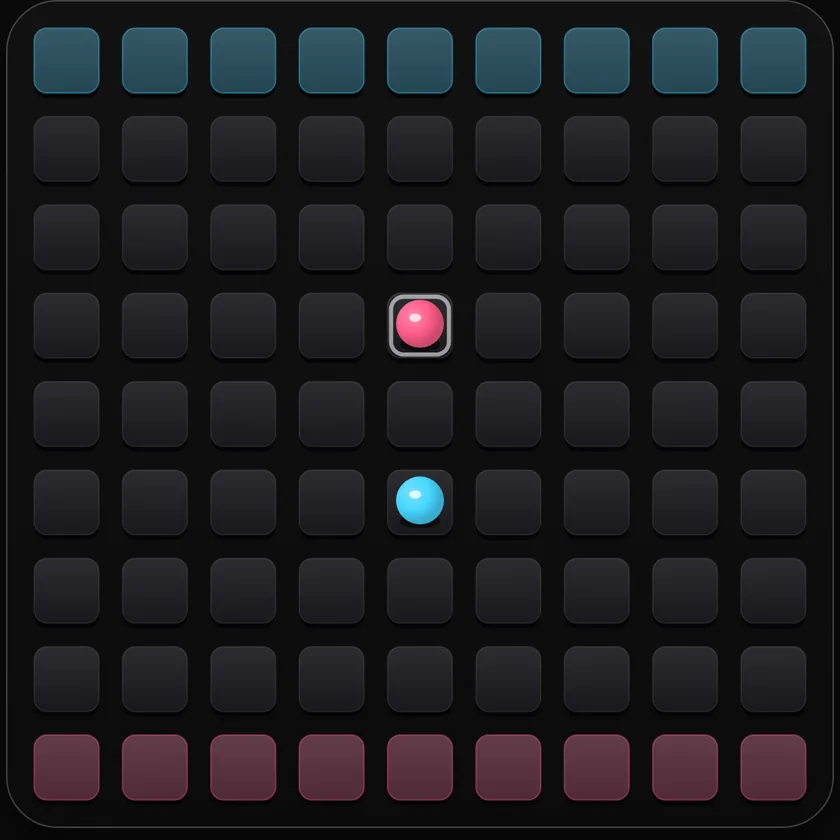
From the first move, the first player scored only 44% in these games. Running straight walks right into the problem from section 2.
4. The sidestep
The first player did better by stepping sideways on move one. f1 scored 56% over 297 games, and d1 50% over 294. It looks like a wasted step, since the ball is no closer to home. But off the middle file the balls don't meet head on, so there is no early jump to give away, and the game is decided by walls later instead.
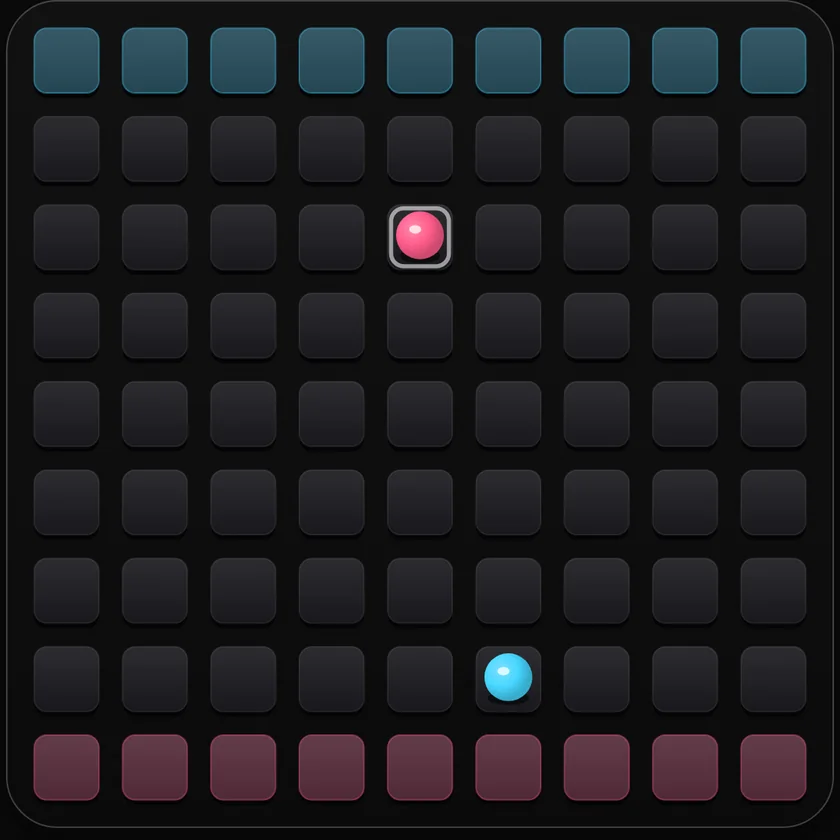
That is why our Advanced and Expert levels now often open with a sidestep. They pick among the good first moves in this book, so their openings vary from game to game.
What this means for your games
- Playing blue? Try a sidestep first move, and keep your walls for later.
- Playing pink? Let blue come to you. If it walks straight into the middle, the jump is yours.
- Either side: before you step next to the other ball, check who would get to jump.
How the numbers were made: our Expert level played itself on 14 threads for an hour, 400 milliseconds a move. To stop the games repeating, each side made a random step 30% of the time in the first eight moves; everything after that is the computer's own choice. Results are counted for the player who made each move. Small samples (a few hundred games) can still move by several points.